What causes a walkway to sink — and how to fix it
⏱️ 7 min read · Last updated: 2026
- Poor soil compaction at installation is responsible for a significant share of sunken walkways — slabs can begin dropping within 2–5 years of poor installation.
- Water erosion is the leading ongoing cause: a single downspout discharging 6 inches from a walkway can wash away several inches of sub-base material per year.
- Mudjacking typically costs $3–$8 per square foot in 2026; polyurethane foam leveling runs $5–$14 per square foot depending on region and slab thickness.
- Walkways that have sunk more than 2 inches are more likely to need full replacement than lifting — the sub-base failure at that depth is usually too widespread to patch.
- Freeze-thaw cycles in northern climates can move a concrete slab up to 1 inch vertically per winter season, compounding soil voids underneath.
The crack ran from the front step to the mailbox post — half an inch wide by April, an inch wide by June. My neighbor had been watching his walkway drop for two years before he called anyone, assuming it was just settling. It wasn’t. What causes a walkway to sink in most residential cases is an active, ongoing process happening underground — and ignoring it makes the repair significantly more expensive.
The honest tension here: most homeowners treat a sunken walkway as a surface problem. It isn’t. The slab itself is usually fine. What’s failing is the 4–12 inches of compacted fill and base material beneath it — and once that material is gone or destabilized, the concrete has nowhere to go but down. I’ve seen jobs where a contractor quoted full replacement at $4,200, but a foam leveling crew fixed the same slabs in 90 minutes for $650. The difference came down to understanding the actual cause first.
The #1 cause most inspectors miss: poor soil compaction
Poor compaction during original installation is the single most common reason walkways sink — and it’s almost never mentioned in the homeowner’s paperwork. When a walkway is poured, the contractor first lays a sub-base of crushed stone or gravel, sometimes over disturbed native soil. If that material isn’t compacted in 4-inch lifts with a plate compactor, it will settle on its own over the next 2–5 years, and the slab above it will follow.
The telltale sign: the slab drops evenly across its entire width rather than tilting toward one edge. When a whole section drops by a uniform 1–2 inches, that’s almost always compaction failure underneath, not erosion on one side. You can confirm this by probing along the slab edge with a long screwdriver — if it slides into the soil more than 3–4 inches with minimal resistance, the sub-base is loose.
This cause is particularly common in walkways installed over backfilled areas — anywhere the ground was excavated for utilities, a foundation, or landscaping and then filled back in. Backfill soil, no matter how carefully placed, takes 3–7 years to approach the density of undisturbed native soil. Pouring concrete on it too soon is asking for movement.

How water erosion hollows out your walkway from underneath
Water is the most active and destructive cause of what makes a walkway sink over time. When water flows across or alongside a walkway repeatedly — from rain, downspouts, irrigation, or snow melt — it infiltrates along the slab edges and gradually carries fine soil particles away. This process is called sub-base erosion, and it creates voids under the slab that can be several inches deep before any surface cracking appears.
The geometry matters here. Notice where your walkway sinks relative to your house’s drainage. A downspout discharging close to the walkway, a sloped yard that channels runoff across the path, or a low spot that pools after rain — any of these concentrate water exactly where it can cause the most damage. In 2026, one of the most underappreciated repair steps is fixing the drainage before lifting the slab, because a lifted walkway over uncorrected water flow will sink again within 2–3 years.
The distinguishing visual: erosion-caused sinking usually tilts the slab toward the water source. One edge drops more than the other. You may also see soil washout visible at the slab perimeter — dark wet soil under the edge, or a visible gap where the concrete no longer meets the ground.
A single downspout discharging 6 inches from a walkway edge can remove enough sub-base material to create a 2-inch void in 18–24 months, particularly in sandy or silty soils.
| Water source | Typical slab movement | Best first fix |
|---|---|---|
| Roof downspout nearby | One-sided tilt, edge cracks | Extend downspout 6+ ft, then lift |
| Yard slope toward walkway | Progressive sinking along one side | French drain, then lift |
| Irrigation overspray | Gradual uniform settling | Adjust heads, seal slab edges |
| Natural low spot / pooling | Center slab drops, edges stay | Regrade yard, then lift |
What freeze-thaw cycles actually do to a concrete slab
Freeze-thaw movement is the cause that surprises most homeowners in northern climates — because the slab sometimes comes back up in spring, masking how much cumulative damage is happening. When soil moisture freezes, it expands by roughly 9%. That expansion pushes concrete upward. When it thaws, the soil contracts — but it doesn’t always contract back to the same position. Each cycle leaves a slightly larger void underneath.
Over 5–10 winters, this ratchet effect can drop a walkway slab by 1–3 inches. The slabs most vulnerable are those with poor drainage underneath them, because saturated soil freezes more aggressively than dry soil. Walkways adjacent to lawn irrigation or in shaded spots that hold moisture are prime candidates.
What this looks like in practice: the walkway rises slightly in January and February, then sits 0.5–1 inch lower in April than it did the previous October. By year 5, that accumulated drop becomes a tripping hazard. Foam leveling works well here because the material is waterproof and doesn’t reabsorb moisture the way compacted fill can — addressing one part of the cycle even if the soil movement continues.
Tree roots, plumbing leaks, and the causes nobody mentions
Tree roots and underground plumbing are two causes that rarely show up in the standard “why does a walkway sink” articles — but they account for a meaningful share of cases where leveling fails and the slab drops again within a year. Understanding these is what separates a permanent fix from a temporary one.
Tree roots
Large tree roots don’t just crack walkways from below — they also steal moisture from the soil. When a mature tree’s root system dries out the clay soil beneath a walkway, that soil shrinks. Clay soil can shrink by 10–15% of its volume when it desiccates, creating voids that drop slabs by 1–2 inches. This is especially common in hot, dry summers following wet springs. The slab often cracks in a pattern that roughly follows the root line.
Plumbing and irrigation leaks
A slow leak in an underground water line beneath or adjacent to a walkway can saturate the sub-base, turning compacted fill into mud. That mud migrates outward, leaving nothing under the slab. Plumbing-related sinking is often asymmetric and faster than erosion — a walkway can drop 2 inches in a single winter if a slow leak has been saturating the soil since fall. If your water bill has crept up without explanation, check this before spending money on leveling.
How do you know which cause is actually your problem?
Diagnosing what causes a walkway to sink in your specific situation is a 6-step process. Each step narrows down the likely culprit before you spend a dollar on repair. These steps work for any slab — front walkway, side path, or patio approach.
- Note the slab movement pattern. Is the slab dropping evenly across its full width, or tilting toward one edge? Even drop = compaction or freeze-thaw. Tilted drop = water on one side.
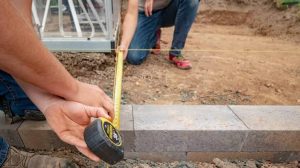
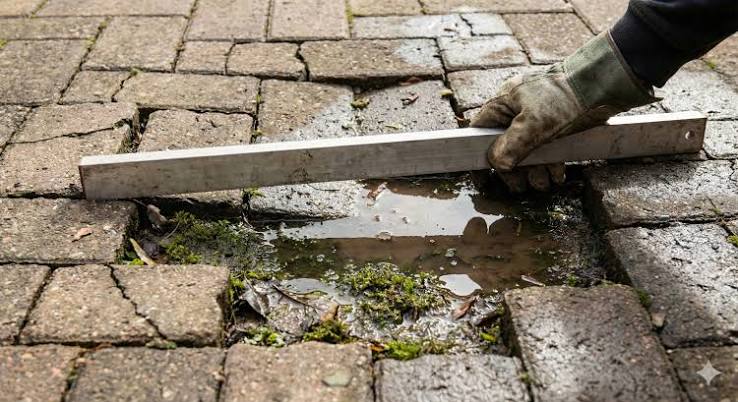
- Check the drop measurement. Use a 4-foot level across the slab. A drop under 1.5 inches is a leveling candidate. More than 2 inches warrants a closer look at whether the sub-base is still intact. Do not skip this step — it directly affects which fix is appropriate and the walkway leveling cost per square foot you’ll pay.
- Probe the soil along slab edges. Push a 12-inch screwdriver into the soil at the low edge of the slab. If it slides in more than 5 inches with light pressure, there’s a significant void or loose material underneath.
- Look for water patterns. Examine the soil and grass around the walkway after a rainfall. Is one side consistently wetter? Is there a visible washout channel at any slab edge? Map where the water goes.
- Check for nearby trees. Any tree within 20 feet with a trunk diameter over 6 inches can affect soil moisture under a walkway. Note whether the cracking or sinking roughly follows a line from the tree toward the slab.
- Review your water bill and check the meter. Turn off all fixtures and watch the meter for 15 minutes. Any movement indicates a leak somewhere in the system — worth ruling out before any repair.
| Cause | Key observable sign | Screwdriver test result | Fix sequence |
|---|---|---|---|
| Poor compaction | Uniform drop, no water nearby | Easy penetration all around | Lift and fill voids |
| Water erosion | One-sided tilt, visible washout | Easy on low side, firm on high | Fix drainage, then lift |
| Freeze-thaw | Seasonal rise/fall pattern | Variable by season | Improve drainage, lift with foam |
| Tree roots / dry soil | Cracks follow root line, dry soil | Hard soil, slab gap visible | Address root, fill void, monitor |
| Plumbing leak | Fast sinking, perpetually wet area | Very easy, mud at tip | Fix leak, wait, then lift |
What actually works to fix a sunken walkway in 2026
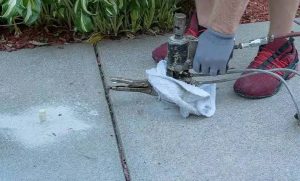
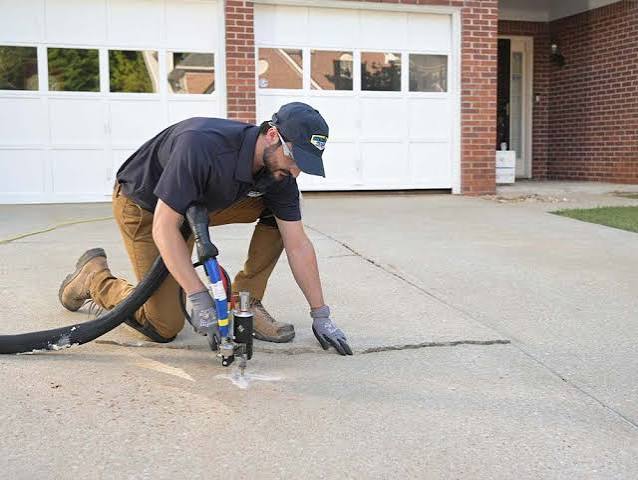
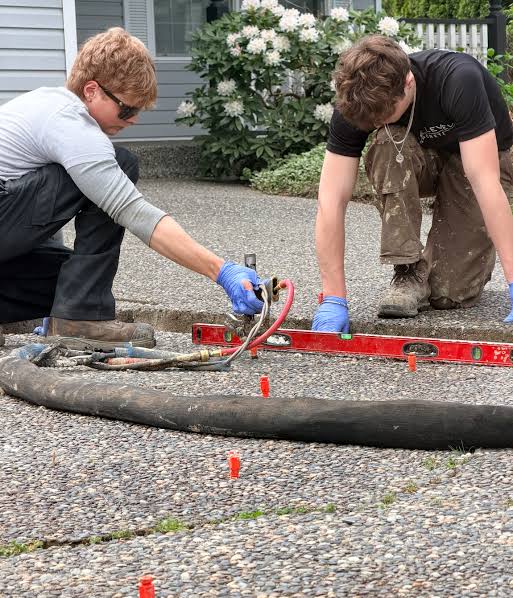
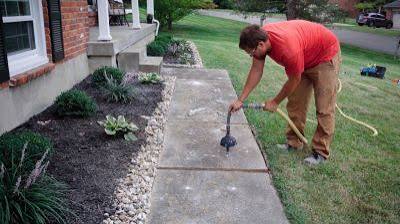
Once you know the cause, the fix becomes much more straightforward. The two methods that dominate in 2026 are mudjacking (pumping a cement-soil slurry under the slab) and polyurethane foam injection (pumping expanding foam that fills voids and lifts the slab). Both work — but for different situations, and at different price points.
Mudjacking costs $3–$8 per square foot and works well when the voids are large and the sub-base is stable. The material is heavy, which matters: if the underlying soil is soft or wet, adding several pounds per square foot of slurry can cause further settlement. Foam injection costs $5–$14 per square foot and is lighter, waterproof, and cures in 15–30 minutes rather than 24–48 hours. For most residential walkways in 2026, foam is the better default — particularly in freeze-thaw climates where the waterproof characteristic matters long-term.
For genuine understanding of which method makes sense for your slab geometry and cause, the detailed breakdown of walkway leveling techniques covers the specifics of each approach with real job examples. If your slab has dropped more than 2 inches or shows structural cracking (not just surface hairline cracks), read through the comparison of when to replace vs lift a sunken walkway before committing to either method — replacement is sometimes the honest answer.
Polyurethane foam leveling cures in 15–30 minutes and adds roughly 2–4 lbs per cubic foot of fill — about one-tenth the weight of mudjacking slurry — making it the stronger choice over soft or wet sub-bases.
Is waiting to fix a sunken walkway ever a good idea?
Waiting is rarely beneficial — and in most cases, it actively increases your repair cost. A slab that drops 1 inch and is caught early can typically be lifted for $200–$400 in foam or mudjacking materials. That same slab, left for another 2–3 winters of freeze-thaw cycling, may develop structural cracks that compromise the concrete itself, moving it from a $400 lift job to a $2,000–$4,500 replacement.
The one situation where waiting makes sense: if you’ve just discovered an active plumbing leak or a major drainage problem. Lifting a slab over a leaking pipe is pointless — the soil will re-saturate and the slab will drop again. In that case, fix the root cause first, allow the soil to dry and stabilize for 4–8 weeks, then schedule the lift. If you’re getting ready to bring in a crew, reviewing how to prepare for a walkway leveling appointment can save time and help the contractor work faster on the day.
The tripping hazard question is a separate calculation entirely. A height differential of 0.5 inches or more between slab sections meets the threshold commonly cited in premises liability contexts — meaning a sunken walkway isn’t just an aesthetic issue. For homeowners with young children or elderly visitors, that changes the urgency timeline significantly.
- The slab itself rarely fails — what causes a walkway to sink is almost always the soil or sub-base material underneath it.
- Diagnose the cause before paying for any repair: water erosion, poor compaction, freeze-thaw cycling, tree roots, and plumbing leaks each require a different fix sequence.
- Slabs dropped less than 2 inches are strong candidates for foam or mudjacking; more than 2 inches warrants a replacement assessment first.
- Fixing the underlying drainage or leak problem before lifting the slab is the step most homeowners skip — and it’s why repairs fail early.
Common questions about what causes a walkway to sink
Why does my concrete walkway keep sinking even after I filled the cracks?
Filling surface cracks doesn’t address the void or unstable soil underneath. The slab sinks because the sub-base is compromised — not because the surface is cracked. You need to either inject material under the slab (foam or mudjacking) or fix the soil condition causing the void. Surface patching is cosmetic only.
How long does it take for a walkway to sink after it’s poured?
Walkways poured over poorly compacted soil typically begin dropping within 2–5 years. Water erosion can cause visible sinking in as little as 12–24 months if drainage is poor. Freeze-thaw related sinking usually becomes noticeable after 3–7 winters of cumulative movement. Fast sinking — under 12 months — often points to an active water leak or extremely poor fill.
Can tree roots cause a concrete walkway to sink rather than just crack?
Yes — though the mechanism is often the opposite of what people expect. Large tree roots dry out clay soil by absorbing moisture, causing the soil to shrink and drop rather than heave. This creates voids under nearby slabs. Trees within 15–20 feet with trunks wider than 6 inches are the most likely contributors to this type of walkway sinking.
Is it cheaper to lift a sunken walkway or replace it?
Lifting is typically 30–60% cheaper than replacement when the slab is structurally intact. Mudjacking runs $3–$8 per square foot; polyurethane foam costs $5–$14 per square foot. Full concrete replacement commonly runs $8–$18 per square foot including demo. Slabs with structural cracks through their full depth or drops over 2 inches may not be good lift candidates, making replacement the more practical choice.
How do I stop my walkway from sinking again after it’s been leveled?
Address the root cause before or immediately after leveling: redirect downspouts at least 6 feet away from the slab, install edge restraints or seal the slab perimeter to block water infiltration, and correct any yard grading that channels water toward the walkway. These steps reduce the chance of repeat sinking by removing the conditions that created the void in the first place.
What is the tripping hazard threshold for a sunken walkway?
A height differential of 0.5 inches (half an inch) between adjacent slab sections is the commonly referenced threshold in premises liability and building accessibility standards. At this point a sunken walkway is not just a cosmetic issue — it creates a measurable fall risk, particularly for elderly individuals. Most concrete repair professionals recommend addressing any drop at or above this threshold.
{“@context”: “https://schema.org”, “@graph”: [{“@type”: “Organization”, “name”: “WalkwayLevelPros.com”, “url”: “https://WalkwayLevelPros.com”, “knowsAbout”: “Walkway Leveling Services: Local Cost, Methods & When You Need It”}, {“@type”: “Article”, “headline”: “What Causes a Walkway to Sink — and How to Fix It”, “description”: “What causes a walkway to sink? Soil erosion, poor compaction, and water damage are the main culprits. Learn how to diagnose and fix it today.”, “datePublished”: “2026-07-11T05:08:14.277851”, “dateModified”: “2026-07-11T05:08:14.277851”, “mainEntityOfPage”: {“@type”: “WebPage”, “@id”: “https://WalkwayLevelPros.com”}, “author”: {“@type”: “Organization”, “name”: “WalkwayLevelPros.com”}, “publisher”: {“@type”: “Organization”, “name”: “WalkwayLevelPros.com”, “url”: “https://WalkwayLevelPros.com”}}, {“@type”: “FAQPage”, “mainEntity”: [{“@type”: “Question”, “name”: “Why does my concrete walkway keep sinking even after I filled the cracks?”, “acceptedAnswer”: {“@type”: “Answer”, “text”: “Filling surface cracks doesn’t address the void or unstable soil underneath. The slab sinks because the sub-base is compromised — not because the surface is cracked. You need to either inject material under the slab (foam or mudjacking) or fix the soil condition causing the void. Surface patching is cosmetic only.”}}, {“@type”: “Question”, “name”: “How long does it take for a walkway to sink after it’s poured?”, “acceptedAnswer”: {“@type”: “Answer”, “text”: “Walkways poured over poorly compacted soil typically begin dropping within 2–5 years. Water erosion can cause visible sinking in as little as 12–24 months if drainage is poor. Freeze-thaw related sinking usually becomes noticeable after 3–7 winters of cumulative movement. Fast sinking — under 12 months — often points to an active water leak or extremely poor fill.”}}, {“@type”: “Question”, “name”: “Can tree roots cause a concrete walkway to sink rather than just crack?”, “acceptedAnswer”: {“@type”: “Answer”, “text”: “Yes — though the mechanism is often the opposite of what people expect. Large tree roots dry out clay soil by absorbing moisture, causing the soil to shrink and drop rather than heave. This creates voids under nearby slabs. Trees within 15–20 feet with trunks wider than 6 inches are the most likely contributors to this type of walkway sinking.”}}, {“@type”: “Question”, “name”: “Is it cheaper to lift a sunken walkway or replace it?”, “acceptedAnswer”: {“@type”: “Answer”, “text”: “Lifting is typically 30–60% cheaper than replacement when the slab is structurally intact. Mudjacking runs $3–$8 per square foot; polyurethane foam costs $5–$14 per square foot. Full concrete replacement commonly runs $8–$18 per square foot including demo. Slabs with structural cracks through their full depth or drops over 2 inches may not be good lift candidates, making replacement the more practical choice.”}}, {“@type”: “Question”, “name”: “How do I stop my walkway from sinking again after it’s been leveled?”, “acceptedAnswer”: {“@type”: “Answer”, “text”: “Address the root cause before or immediately after leveling: redirect downspouts at least 6 feet away from the slab, install edge restraints or seal the slab perimeter to block water infiltration, and correct any yard grading that channels water toward the walkway. These steps reduce the chance of repeat sinking by removing the conditions that created the void in the first place.”}}, {“@type”: “Question”, “name”: “What is the tripping hazard threshold for a sunken walkway?”, “acceptedAnswer”: {“@type”: “Answer”, “text”: “A height differential of 0.5 inches (half an inch) between adjacent slab sections is the commonly referenced threshold in premises liability and building accessibility standards. At this point a sunken walkway is not just a cosmetic issue — it creates a measurable fall risk, particularly for elderly individuals. Most concrete repair professionals recommend addressing any drop at or above this threshold.”}}]}, {“@type”: “BreadcrumbList”, “itemListElement”: [{“@type”: “ListItem”, “position”: 1, “name”: “Home”, “item”: “https://WalkwayLevelPros.com”}, {“@type”: “ListItem”, “position”: 2, “name”: “Walkway Leveling Services: Local Cost, Methods & When You Need It”}, {“@type”: “ListItem”, “position”: 3, “name”: “What Causes a Walkway to Sink — and How to Fix It”}]}]}
See also: walkway leveling
See also: how to prepare for walkway leveling appointment
See also: when to replace vs lift a sunken walkway
Related: polyurethane lifespan
Related: polyjacking vs mudjacking for clay soil
Related: polyjacking vs mudjacking for freeze-thaw climates