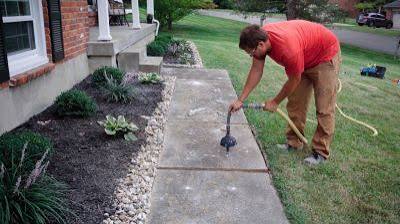
Concrete leveling method comparison chart: real costs, timelines, and what actually works
⏱️ 8 min read · Last updated: 2026
If you are deciding between foam jacking, mudjacking, and full replacement, the right choice depends on one thing: whether the slab is still structurally sound. This concrete leveling method comparison chart breaks down real costs, timelines, lifespan, and use cases so you can choose the most practical fix for your walkway, driveway, patio, or other settled slab.
Source: www.a1concrete.com
- Foam jacking averages $3–$6 per sq ft, mudjacking averages $5–$8 per sq ft, and full replacement averages $8–$15 per sq ft.
- Foam jacking takes 2–4 hours for a typical walkway, while mudjacking takes 4–6 hours and full replacement takes 2–5 days including cure time.
- Properly installed foam leveling lasts 10–20 years in most soil conditions, compared with 5–10 years for mudjacking.
- Cement slurry used in mudjacking weighs 100–120 lbs per cubic foot, while cured polyurethane foam weighs 2–4 lbs per cubic foot.
- The ideal temperature range for any concrete leveling method is 50°F–80°F.
A mudjacking crew quoted my neighbor $1,900 to lift a 150-square-foot walkway that had settled about two inches on one side. The foam leveling company next door did a similar job for $750 in under three hours. That price gap made the comparison impossible to ignore.
The right choice is not always the cheapest bid, and the most expensive option is not always necessary. A full slab replacement at $8–$15 per square foot makes sense when the concrete is structurally cracked and crumbling. For a walkway that has simply settled unevenly, paying three to five times more than needed is wasteful.
After three years of watching crews work, comparing invoices, and checking jobs again at the six-month and two-year marks, one pattern is clear. The company brochures do not always match what happens in the field, especially when soil conditions, slab thickness, and drainage problems get ignored.
Which concrete leveling method saves the most money in 2026?
Foam jacking saves the most money for most settled-but-intact slabs in 2026. It typically runs $3–$6 per square foot, which is about 30–40% less than mudjacking for a typical residential walkway or driveway section.
That price changes with access, slab thickness, lift depth, and injection-point count. A walkway with easy street access and a one-inch lift might land near $3 per square foot. A backyard patio behind a fence that needs a three-inch correction will usually move closer to $6.
Mudjacking sits in the middle at $5–$8 per square foot. It has remained the default method for decades, and in many Midwest and Southern markets, more crews competing for work helps keep prices down. According to the concrete leveling statistics, that competition can keep costs 15–20% lower than in newer foam-dominant regions.
Full replacement rises to $8–$15 per square foot and can cost more for decorative finishes or complex sub-base work. That price includes demolition, hauling, new sub-base preparation, and pouring. A 200-square-foot driveway section can reach $2,000–$3,000 for replacement, compared with $600–$1,200 for leveling.
Ask every contractor for a price that includes the injection point count. A foam company quoting $4 per square foot with 12 injection points is not the same as one quoting $4 with 20 points. More points usually mean more precise leveling, but they also increase the real cost.
The raw number is only the starting point. If mudjacking needs to be redone every 5–10 years and foam holds for 10–20 years, the lifetime cost picture changes fast. That is why concrete leveling vs replacement cost should always be compared over time, not just at the invoice line.
How long does each concrete leveling method actually take?
Foam jacking is the fastest option for most residential jobs. A typical walkway or single-car driveway section usually takes 2–4 hours, and the surface is often walkable within 30 minutes.
Mudjacking takes longer, usually 4–6 hours for the same job. The cement-based slurry needs larger holes, more injection points, and more time to begin setting. Foot traffic is usually safe after 24 hours, and vehicle traffic usually waits 48–72 hours.
Full replacement takes 2–5 days from demolition through initial cure. Day one is removal, day two is sub-base preparation, and day three is the pour. After that, the slab still needs 48–72 hours before foot traffic and 7 days before vehicles. The Portland Cement Association recommends 28 days for concrete to reach its designed compressive strength before heavy loads.
Timing matters for more than convenience. If the walkway is your only path from the driveway to the front door, replacement can block access for days. Foam jacking gets you back to normal the same afternoon.
Temperature also matters. The ideal range for any concrete leveling method is 50°F–80°F. If you want the best seasonal timing, see the best time of year for concrete leveling.
The side-by-side comparison chart
This concrete leveling method comparison chart focuses on the factors that actually affect your decision: cost, speed, weight, lifespan, and the kind of slab each method suits best. It is the quickest way to separate a repair that fits from one that wastes money.
| Factor | Foam jacking (polyjacking) | Mudjacking | Full replacement |
|---|---|---|---|
| Cost per sq ft | $3–$6 | $5–$8 | $8–$15+ |
| Total for 150 sq ft | $450–$900 | $750–$1,200 | $1,200–$2,250+ |
| Time to complete | 2–4 hours | 4–6 hours | 2–5 days |
| Hole size drilled | 5/8 inch | 1–2 inches | N/A (full demo) |
| Weight added to soil | 2–4 lbs/sq ft | 12–18 lbs/sq ft | Full slab weight |
| Expected lifespan | 10–20 years | 5–10 years | 20–30 years |
| Walk-on ready | 30 minutes | 24 hours | 48–72 hours |
| Vehicle ready | Same day (light) | 48–72 hours | 7+ days |
| Best for | Intact settled slabs | Thick slabs, tight budgets | Crumbled or damaged slabs |
| Worst for | Very thick slabs (6″+) | Soft clay soil, thin slabs | Tight budgets |
For a walkway, foam jacking wins on most metrics. It is faster, lighter on the soil, uses smaller holes, and usually costs less. Mudjacking still makes sense when the slab is unusually thick, 6 inches or more, and settlement is minimal, under an inch.
Closed-cell polyurethane foam also carries an R-value of approximately 3.5 per inch. That means it can add a thin insulating layer under the slab and marginally reduce frost penetration, which cement slurry and gravel replacement cannot do. For more on how materials affect performance, see polyurethane foam injection pros and cons.
Use the chart as a decision matrix. If your slab is settled but structurally sound, foam jacking offers the best mix of cost, speed, and longevity. If the slab is cracked through or crumbling, leveling will not fix the underlying material failure.
| If your slab… | Choose… | Why |
|---|---|---|
| Has settled 1–3 inches but is crack-free | Foam jacking | Cheapest, fastest, longest-lasting fix |
| Is thick (6″+) and settled less than 1 inch on stable soil | Mudjacking | Slurry weight adds stability; lower cost |
| Is cracked through or crumbling at edges | Full replacement | Leveling cannot fix material failure |
| Needs drainage correction alongside leveling | Replacement + grading | Leveling does not address water flow |
| Was previously mudjacked and settled again | Foam jacking (try first) | Less weight on already-compromised soil |
How mudjacking works — and when it is still the right call
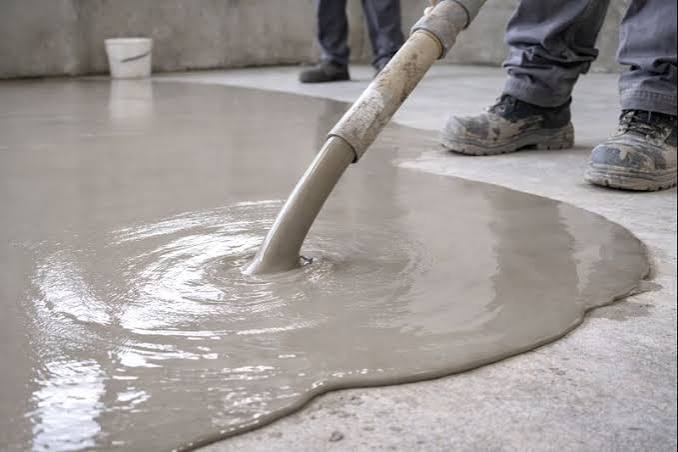
Mudjacking pumps a cement-based slurry made from Portland cement, topsoil, and water through 1–2 inch holes drilled into the sunken slab. The slurry fills the void beneath the concrete and lifts it back to level. It has been the residential standard since the 1920s because it still works when conditions are right.
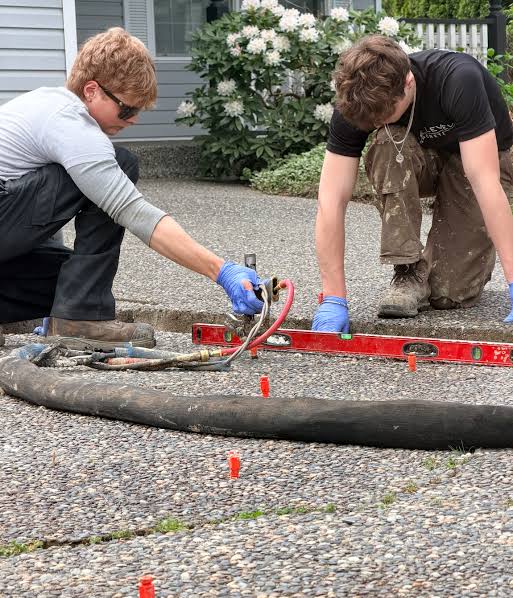
The process follows a predictable sequence. First, the crew marks the low points and injection locations, usually 1–3 feet apart. Then they drill with a 1.5-inch masonry bit, mix the slurry on site, pump it under pressure, monitor lift with a laser level, and patch the holes with color-matched cement.
Mudjacking makes the most sense when the slab is thick, usually 6 inches or more, when budget is the main constraint, or when the soil below is already compacted and stable. It is also more common in rural areas where foam crews are less available. Industry surveys compiled in concrete leveling statistics reports say mudjacking still accounts for roughly 55–60% of all residential leveling jobs in the United States as of 2025.
The drawbacks are just as important. Cement slurry weighs 100–120 lbs per cubic foot, or about 12–18 lbs per square foot in this application, which can be a problem on soft or clay-heavy soils. The larger drill holes are more visible after patching, and the 5–10 year lifespan means you may be facing the same repair again sooner than you want. For a longer look at durability, see how long concrete leveling lasts.
How foam jacking works and why the price gap is shrinking
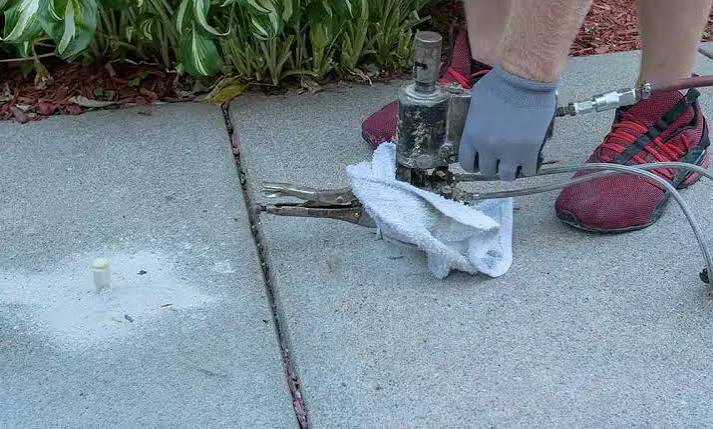
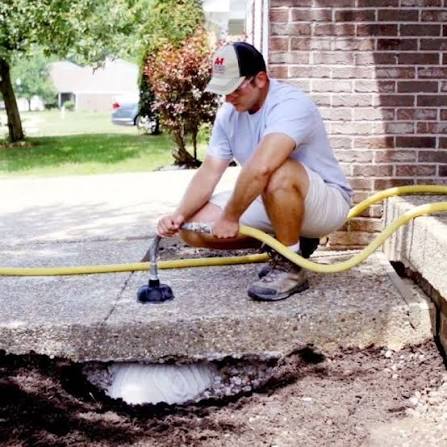
Foam jacking uses expanding polyurethane foam injected through small 5/8-inch holes. The foam expands to fill voids, compact loose soil, and lift the slab within minutes. Residential use surged after 2018 as more crews bought the equipment and the process became easier to find.
The process mirrors mudjacking in structure but not in execution. Crews mark low points, drill small holes, inject the foam, monitor lift in real time, patch the holes, and leave the surface walkable within 30 minutes. The foam usually cures in about 15–20 minutes.
The price gap has narrowed since 2022. Foam used to cost 40–50% more than mudjacking, but in 2026 the premium is often closer to 15–25% in competitive markets. In some areas, foam is actually price-competitive with mudjacking for smaller jobs like walkways.
The technical edge comes from expansion. Foam fills cracks and voids in the sub-base as it cures, while slurry only moves where pressure pushes it. That expansion gives foam a more uniform lift and helps results hold up better over time. It also displaces moisture, which helps in wet climates where water pooling beneath slabs speeds settlement.
If you want a broader overview of repair outcomes, walkway leveling usually performs best when the concrete is intact and the soil problem can be stabilized instead of rebuilt.
When full slab replacement is the only honest answer
Full replacement is the right call when the concrete itself is failing. If the slab is cracked through, crumbling, showing exposed rebar, or so weak that a screwdriver can push into the surface, leveling will not solve the problem.
Replacement is also necessary when the slab is too thin to level safely, usually under 3 inches, when previous mudjacking or foam work has failed and the soil is beyond repair, when grade or drainage must change, or when tree roots have heaved the slab and need to be cut or managed first.
The process takes 2–5 days and usually costs $8–$15 per square foot for a standard residential walkway or driveway section. Decorative finishes such as stamped or stained concrete can push that to $12–$20 per square foot. If you are planning the work seasonally, the best time of year for concrete leveling is still spring or fall.
I saw this exact call last year. A client had a walkway with about 20 cracks, most hairline but three clearly full-depth. The slab had already been mudjacked twice. Leveling it a third time would have been expensive false economy, so we replaced it for about $2,400 and have not touched it since.
Is concrete leveling worth it for a beginner in 2026?
Yes, concrete leveling is one of the easier home repair decisions for a beginner, as long as you hire the right crew. You do not handle sub-base prep, concrete mixing, or curing schedules. A good foam or mudjacking team manages the whole process in one visit.
The best first-time approach is simple. Measure the settlement, check for structural damage, get three quotes, confirm the warranty in writing, check licensing, and be present during the job.
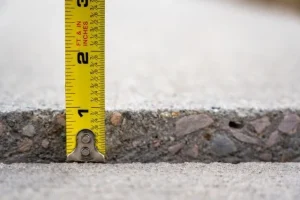
Start by placing a straightedge across the slab and measuring the gap at the lowest point. Then inspect the walkway for full-depth cracks, crumbling edges, or exposed aggregate. Surface hairline cracks are cosmetic. Cracks large enough to fit a quarter into are structural, and that usually changes the repair decision.
When you request quotes, ask for the per-square-foot price, the number of injection points, and the warranty terms. Foam leveling companies often offer 2–5 year warranties, and some offer lifetime warranties. Read the fine print carefully, because a lifetime warranty that covers only the foam material and not the labor to re-inject is far less useful than it sounds.
Taking clear before-and-after photos from the same angle helps you track the results and compare bids accurately. In most states, concrete leveling requires a general contractor or specialty concrete license. During the job, stay nearby and watch the slab rise. Most crews appreciate an engaged homeowner, because it prevents confusion and callbacks later.
What goes wrong when you choose the wrong method
The biggest mistake is not foam versus mudjacking. It is choosing leveling when replacement was needed, or choosing replacement when leveling would have fixed the problem for much less money.
Five mistakes show up again and again. Leveling a slab that should be replaced leaves you with a level slab that still falls apart. Choosing mudjacking on soft soil can make the slab settle again because clay and organic soils compress under the added weight. Ignoring drainage just resets the timer. Taking the cheapest quote without asking questions often means fewer injection points or an unlicensed crew. Waiting too long turns a simple trip hazard into a bigger repair.
That last point matters. In many jurisdictions, property owners are responsible for injuries caused by uneven walkways. A minor slip-and-fall claim can still become expensive once medical bills and legal costs are added. A $500–$1,000 leveling job can eliminate that risk entirely.
Good contractors will tell you when leveling is not the answer, even if it costs them the job. If a company only offers one technique and says it fits every situation, treat that as a red flag. For more context on method choice, compare polyjacking vs mudjacking for freeze-thaw climates before you commit.
- Foam jacking at $3–$6 per sq ft is the best value for settled-but-intact slabs in 2026.
- Full replacement at $8–$15 per sq ft is only necessary when the concrete is structurally compromised.
- Ask for injection point counts, written warranties, and drainage fixes where needed.
- Plan work for spring or fall, when temperatures stay between 50°F and 80°F.
Common questions about the concrete leveling method comparison chart
Can you walk on a concrete walkway right after foam leveling is done?
Yes. Closed-cell polyurethane foam cures in roughly 15–20 minutes, and most crews say the surface is safe for foot traffic within 30 minutes. Light vehicle traffic under 5,000 lbs is usually fine the same day. Heavy vehicles should wait 24 hours.
Does mudjacking damage the existing concrete slab?
Mudjacking can cause hairline cracks in thin or brittle slabs because the larger 1–2 inch drill holes and higher injection pressures stress the concrete more. Slabs thicker than 4 inches in good condition rarely have issues. A slab inspection before work starts is the safest approach.
How much does concrete leveling cost per square foot in 2026?
In 2026, foam jacking averages $3–$6 per square foot, mudjacking averages $5–$8 per square foot, and full replacement runs $8–$15 per square foot. Actual prices vary by region, slab thickness, access difficulty, and injection-point count.
What is the difference between polyjacking and foam jacking?
Polyjacking and foam jacking are two names for the same process: injecting expanding polyurethane foam beneath a concrete slab to lift and stabilize it. Always confirm that the crew is using closed-cell foam, not open-cell insulation foam.
Will sunken concrete level itself out over time without intervention?
No. Sunken concrete does not reverse on its own. Settlement happens because soil compacts, erodes, or washes away beneath the slab, and that process only moves in one direction. The only ways to restore level are mudjacking, foam jacking, or full replacement.
How do I know if my walkway needs leveling or full replacement?
Leveling works when the concrete is intact but settled, with no full-depth cracks, crumbling edges, or exposed rebar. If you can fit a quarter into a crack, it usually runs through the slab, and leveling will not fix the structural problem.
How long does foam concrete leveling last compared to mudjacking?
Foam jacking typically lasts 10–20 years in stable soil conditions. Mudjacking usually needs to be redone every 5–10 years. The difference comes down to weight: foam adds 2–4 lbs per sq ft to the soil, while mudjacking slurry adds 12–18 lbs per sq ft.
The bottom line
For most sunken walkways and driveways, foam jacking in 2026 gives you the best return on your dollar. It is faster, lighter on the soil, uses smaller holes, and lasts longer than mudjacking without the price gap that used to make it hard to justify.
Reserve full replacement for concrete that has truly failed structurally, not just settled. If you are still undecided, go outside with a straightedge and a tape measure, record the settlement, and then call three companies — one foam crew, one mudjacking crew, and one that offers both.
The concrete leveling method comparison chart only works if you apply it to your own slab conditions. Measure first, compare second, and choose based on structure, soil, and drainage rather than price alone.
For the full breakdown of when each method wins and loses, see our guide on Mudjacking vs Polyjacking vs Replacement: Choosing the Right Method.
See also: walkway leveling
See also: concrete leveling statistics
See also: best time of year for concrete leveling
Related: polyjacking vs mudjacking for freeze-thaw climates
Related: concrete leveling vs replacement cost
Related: polyurethane foam injection pros and cons
See also: how to choose a concrete leveling method
See also: concrete leveling method statistics
See also: walkway leveling cost per square foot